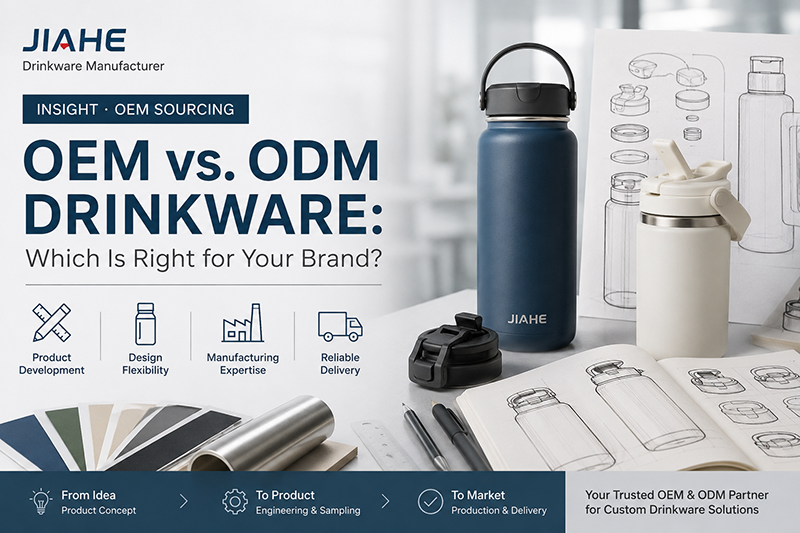
OEM vs. ODM Drinkware: Which Is Right for Your Brand?
When a brand starts looking for a drinkware manufacturer, one of the first questions is usually:
“Do you offer OEM or ODM?”
The short answer is often: both.
But the difference between OEM and ODM is more useful when you look at how a real product is developed, rather than just comparing two textbook definitions.
A stainless steel bottle, for example, is not simply a bottle body. There is the stainless steel construction, vacuum insulation, lid, sealing components, surface finish, printing, assembly and packaging. Depending on how much of the product has already been defined by the brand, the manufacturer's role can be very different.
For brands and sourcing teams, the real questions are usually more practical:
How much of the product do I need to design myself? How much can the manufacturer help with? How much customization is realistic? And which approach makes sense for my project?
OEM vs. ODM: What Is the Difference?
In a typical OEM project, the buyer already has a relatively clear product specification.
You may already have:
A CAD drawing or product sample
Defined dimensions and capacity
Material requirements
A specific lid design
Surface finish and color requirements
Branding and packaging specifications
The manufacturer's main responsibility is to turn those requirements into a stable production process and deliver the product consistently.
ODM is more development-oriented.
You may have a product concept, a reference sample, or an existing product that you want to develop further, but not every detail is finalized. In this case, the manufacturer can become more involved in the development process, helping review the structure, materials, components or manufacturing approach.
For drinkware, the line between OEM and ODM is not always clear-cut. A project can start with an existing product and gradually become more customized.
That is actually quite common.
A Practical Comparison
OEM | ODM | |
|---|---|---|
Starting point | Defined design, sample or specification | Product concept or existing platform |
Design responsibility | Mainly the buyer | Shared or manufacturer-supported |
Customization | Based on buyer requirements | Depends on the product and development scope |
Engineering support | Usually project-specific | Usually more involved |
Tooling | May require custom tooling | Existing or modified tooling may be possible |
Development approach | Manufacture a defined product | Develop and manufacture a product |
Best suited for | Established product concepts | New products or brands needing development support |
The important point is that ODM does not simply mean buying an off-the-shelf product.
And OEM does not mean the manufacturer has no role in product development.
In a well-managed project, there is usually some discussion between the two sides before production begins.
When OEM Makes More Sense
OEM is often the straightforward choice when your product is already defined.
For example, you may already have a bottle design that has been tested in your market. You know the capacity, dimensions, materials, colors and branding. What you need is a manufacturing partner that can reproduce the product reliably at your required volume.
In this situation, the manufacturer's focus is largely on manufacturing execution.
That includes questions such as:
Can the stainless steel body be formed consistently?
Is the vacuum insulation process stable?
Can the lid be produced to the required dimensions?
Are the silicone seals working properly?
Can the surface finish meet the approved sample?
Can printing or laser engraving remain consistent from batch to batch?
Can the product be assembled and packed according to the specification?
This is where the difference between a factory that simply takes an order and a manufacturer that understands the product becomes important.
A good OEM partner should be able to point out a manufacturing problem before it becomes a production problem.
For example, a particular bottle shape may look fine in a rendering but create difficulties during forming. A lid design may work in a prototype but require adjustment for reliable injection molding or assembly.
That kind of feedback is part of a useful manufacturing relationship.
When ODM Makes More Sense
ODM can be a better fit when you know what you want the product to achieve, but you do not yet have every detail worked out.
Perhaps you want to launch a new insulated sports bottle, but you are still deciding:
Which bottle shape is practical?
What capacity should be used?
Which type of lid works best?
Should the bottle use a straw or direct-drinking design?
Which components should be customized?
What surface finish fits the target market?
Which parts require new tooling?
In this situation, having a manufacturer involved earlier can save time.
An experienced drinkware manufacturer can help look at the product from a production point of view. The discussion is not only about how the product should look, but also about how it will be made, assembled, tested and eventually produced in volume.
This is especially useful for drinkware because the lid and bottle body need to work as one system.
A beautiful bottle body does not solve a poorly designed lid. A good lid does not help if the bottle neck, sealing components or assembly process are not properly matched.
The Best Solution Can Be a Combination of OEM and ODM
This is where many real drinkware projects end up.
A brand might already have a bottle body it likes but want to develop a different lid.
Another brand may start with an existing lid structure and request a new bottle shape, capacity, finish or branding.
A third brand may use an existing product platform as a starting point and gradually develop more proprietary elements as the product moves through sampling.
These projects are not necessarily “pure OEM” or “pure ODM.”
They are simply custom development projects with different levels of manufacturer involvement.
For buyers, this can actually be a useful approach.
You do not necessarily need to redesign every component from zero to create a product that feels distinctive. At the same time, using an existing platform does not mean your finished product has to look generic.
The right balance depends on your product positioning, budget, development schedule and the level of differentiation you need.
What Can Actually Be Customized?
This is one of the questions we recommend discussing early.
For drinkware, customization can involve much more than putting a logo on an existing bottle.
Depending on the project, customization may include:
Bottle body
Shape, dimensions, capacity, wall construction and other structural details.
Lid
Drinking mechanism, opening method, handle, spout, straw configuration and other components.
Color and surface finish
Powder coating, printed graphics, laser engraving and other finishing options.
Branding
Logo placement, printing, engraving and other brand elements.
Packaging
Box style, artwork, inserts and other packaging requirements.
Not every component needs to be redesigned for every project.
Sometimes the smartest solution is to customize the part that matters most to the brand while keeping other proven components unchanged.
That can reduce unnecessary development work without making the final product feel like a standard catalog item.
What Should You Ask a Drinkware Manufacturer Before Starting?
The words OEM and ODM only tell you so much.
Before starting a project, we recommend asking a manufacturer some very practical questions.
1. Can you work from my CAD drawing or sample?
If you already have a design, the manufacturer should be able to understand your drawings, dimensions and specifications and identify any production concerns.
2. Which parts can actually be customized?
Do not assume every factory can modify every component. Ask specifically about the bottle body, lid, handles, seals, finishing and packaging.
3. Can your engineering team review the design?
A useful manufacturer should be willing to discuss whether a design is practical to manufacture, not simply quote a price.
4. What tooling will be required?
Find out which parts require new tooling, which can use existing tooling, and how tooling costs and ownership will be handled. Clarify shipping responsibilities early by agreeing on the appropriate Incoterms rule (e.g., FOB, CIF, DDP) before production begins.
5. What happens after the first sample?
Sampling is only one step. Ask how revisions, approvals, production preparation and quality control will be handled before mass production.
These questions usually tell you much more about a manufacturer's capabilities than simply asking whether they offer “OEM and ODM.”
What OEM and ODM Look Like at JIAHE
At JIAHE, our work covers both manufacturing and product-development support.
Our manufacturing processes include stainless steel tube cutting and forming, welding and sealing, vacuum insulation, injection molding, surface treatment, printing and product assembly. This allows us to look at a drinkware project as a complete product rather than treating the bottle body and lid as completely separate businesses.
For OEM projects, we can work from a customer's drawings, samples or product specifications and focus on turning the requirements into consistent production.
For ODM and customized projects, we can also discuss product structure, components, materials and manufacturing feasibility during development.
Our experience with drinkware lids is particularly useful when a project requires more than a standard bottle. A lid affects how the product is used, how it seals, how it is assembled and, ultimately, how the customer experiences the product.
That is why we prefer to discuss the whole drinkware system rather than only the stainless steel body.
So, Which One Is Right for Your Brand?
If your product design is already finished and you mainly need a capable manufacturing partner, OEM may be the most straightforward approach.
If you have a product concept but need technical and manufacturing input to turn it into a finished product, ODM may make more sense.
And if you are somewhere in between, that is completely normal.
Many drinkware projects combine elements of both.
The more important question is not whether a manufacturer calls itself an OEM factory or an ODM factory.
It is whether the manufacturer can understand your product, communicate clearly about what is practical, manage the development process and support the product through sampling and mass production.
Start with the product you want to build. The right OEM or ODM approach usually becomes much clearer from there.
FAQ
What is the difference between OEM and ODM drinkware?
OEM usually starts with a product design or specification provided by the buyer. ODM involves more participation from the manufacturer during product development. In drinkware, a project can also combine both approaches.
Is ODM only for standard products?
No. ODM can start from an existing product platform, but the level of customization can vary considerably. Components such as lids, bottle bodies, finishes, colors and branding may be customized depending on the project.
Can I customize an OEM water bottle?
Yes. OEM projects can involve extensive customization when the product requires new tooling or customer-specific components. The exact scope depends on the design and manufacturing requirements.
Do I need a CAD drawing to start an OEM or ODM project?
Not necessarily. A CAD drawing is useful, but an existing sample, reference product, dimensions or even an initial product concept can be enough for an early discussion.
Can a manufacturer provide both OEM and ODM services?
Yes. A manufacturer can support both types of projects. What matters is understanding how much product-development support is actually available and which parts of the manufacturing process the factory can handle.